Radigan's Razor
A Life to Fit in a Backpack, Via Negativa & Moby Dick

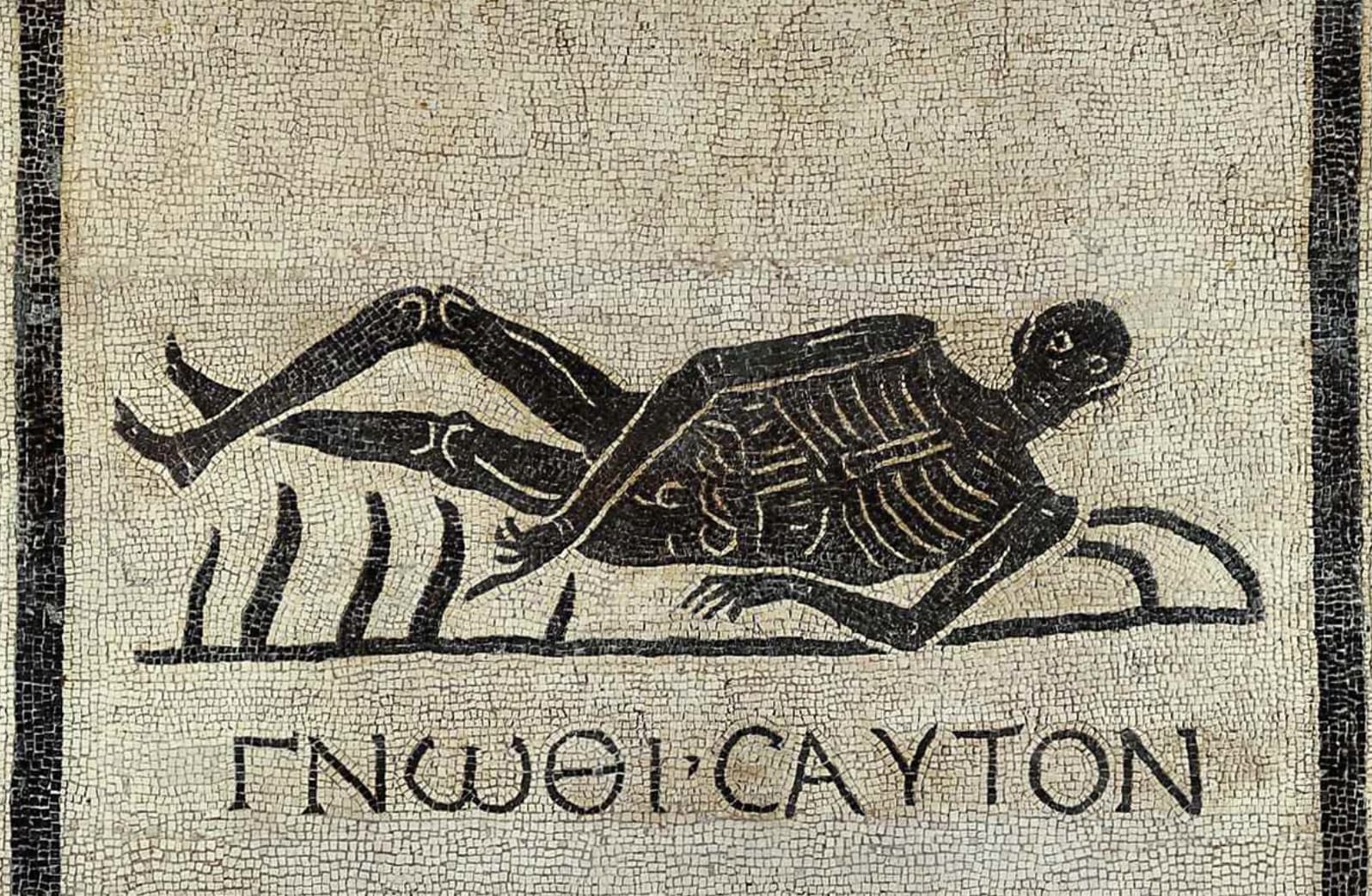
Know Thyself: Memento Mori from excavations in the convent of San Gregorio in Rome, Italy
Herman Melville’s Moby Dick is beloved for its opening line, “Call me Ishmael.” But it’s what follows this opener that has led me to return to its pages over and over again.
It is a way I have of driving off the spleen and regulating the circulation. Whenever I find myself growing grim about the mouth; whenever it is a damp, drizzly November in my soul; whenever I find myself involuntarily pausing before coffin warehouses, and bringing up the rear of every funeral I meet; and especially whenever my hypos get such an upper hand of me, that it requires a strong moral principle to prevent me from deliberately stepping into the street, and methodically knocking people’s hats off—then, I account it high time to get to sea as soon as I can.
I cherish this passage because I know the feeling, but it also because it makes me laugh. Melville’s writing has a certain whistling in the dark quality to it that I aspire to in life. There’s also something about Ishmael’s sentiment that feels as if it could have been written today, despite being nearly 175 years old. I shouldn't be surprised; I seem to feel that way about a lot of old things I read. Humans haven’t changed all that much through the millennia, and it’s only us moderns who think we’re comparably enlightened. I digress…
Unlike Melville’s Ishmael, my “damp, drizzly November in my soul” is much more likely to have me knocking my own hat off than a stranger’s in the street. I seem to relocate myself through some kind of zero-based living, which results in me obliterating myself back to zero in order to see what comes back on its own accord. In college I called these quarter-life crises, both due to my age at the time and also because it seemed to happen every academic quarter. It was during one of these Novembers in my soul that I recently found myself ruminating on an essay written by Radigan Carter, who is a military veteran, investor, and defense contractor.
For 27 months, through attacks and every day life, I only had what I could fit in a backpack — a change of clothes, gym clothes, MacBook, fighting kit…the Louis Vuitton sunglasses lol.
In his essay “Taking the Long View” Radigan Carter describes happily living with little as a defense contractor in Afghanistan and the experience of returning home to the United States to find a storage container full of possessions that used to matter to him. The feeling that none of his things meant what they once did led him to ask what he actually wanted, so he sold everything and made a list.
The list was short - Go back overseas, keep traveling, get my deadlift to 500 lbs.
I read this section a dozen times, trying to figure out why I was obsessing over it and why my life felt comparably unfocused at that moment. The attraction was simplicity; the attraction was living on intuition and tying your actions to the truest sense of self.
A Philosophical EDC
My life is sometimes given to overflowing. I have three children five and under, and they come with a surprising amount of stuff. But moreso, it’s the accumulation of aspirations and the things that are supposed to pull us closer to what we want to be. The books to read, the notebooks with abandoned novels, the guitar amps meant for a stage now collecting dust, clothes that no don’t fit or never looked good to begin with, ideas held onto for too long.
So I decided to take Radigan’s essay literally. I made a list of what I wanted to do most immediately and kept it to three things. That part was surprisingly easy. I think we all already know the answers. What surprised me was how the rational mind tried to add things I’m supposed to want to do. Am I provincial if travel didn’t make the cut?
My list included writing, lifting weights, and family. The trick is to not let the rational brain add anything extra.
Then I imagined my own backpack — what clothes, tools, and other necessities would I bring in pursuit of the list above? This is not literally a go-bag, but the physical manifestation of knowing yourself. A weekend bag for life. It’s nice to know what you’d wear if you had to choose one thing, the best thing for you. It’s nice to know what book you’d grab for a long weekend, the notebook and pen to bring (my version of Radigan’s “fighting kit” lol).
I fear I’m risking pedantry here, but there’s something powerful about this framework. The Romans believed in via negativa, or finding the truth by describing what something isn’t. That’s what the “Novembers of the soul” are about, the feeling that whatever it is — as the kids say — this ain’t it. Or to return to Melville’s first chapter heading in Moby Dick: “Loomings.”
The answer to this looming is what I’m calling “Radigan’s Razor.” The answers almost always lie in the simplest formation, on the gut level rather than the brain. Being of a certain class in America that seeks to build and express oneself through consumerism, the truth is that the additive subtracts, and the things added to us mostly exist to enrich those smart enough to resist. I want my life to be focused enough to fit in a backpack, so it can overflow in simple abundance.
-Nate
What I’m listening to: Zach Bryan
What I’m reading: The Story of My Life by Giacomo Casanova